
Health & Lifestyle · 2,500+ words · Last updated June 2026
A few years back, I hit a wall. Not a dramatic burnout, nothing cinematic — just a slow, creeping feeling that I was running on fumes every single day. My sleep was off, my eating was chaotic, and I genuinely couldn’t remember the last time I felt good for no particular reason.
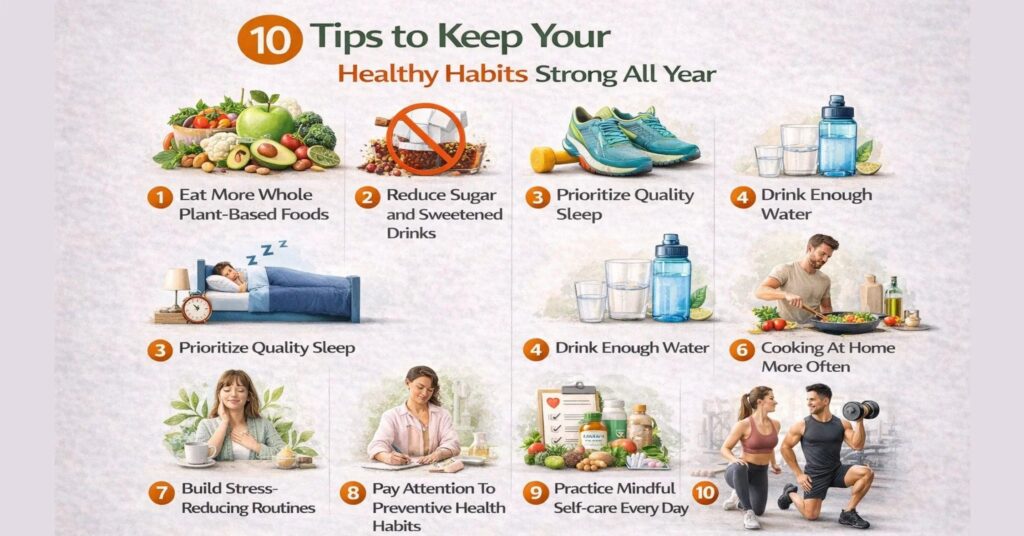
What followed was about two years of trial and error — trying different routines, dropping them, picking them back up, reading way too many threads on Reddit, and finally landing on a set of habits that genuinely changed how I feel day to day. Nothing extreme. Nothing that requires a gym membership or a lifestyle overhaul. Just small, consistent shifts that stack up over time.
This article is the collection of what actually worked, what I got wrong, and what I wish someone had told me earlier. Wellness can feel overwhelming when you approach it all at once, so let’s break it down the way I did — one piece at a time.
Why Wellness Feels So Hard to Maintain
Here’s the honest truth: most wellness advice is written as if you have eight free hours a day and zero responsibilities. Meal prep every Sunday, journal every morning, meditate twice daily, hit 10,000 steps — it all sounds manageable in theory. Reality is different.
The real problem isn’t motivation. Plenty of people are motivated in January. The problem is threshold — the minimum effort required to start a habit. When the threshold is too high, life gets in the way and the habit vanishes. Lowering that threshold is the actual game.
“The secret to lasting wellness isn’t discipline. It’s making the healthy choice the easy choice.”
That reframe changed everything for me. Once I stopped measuring success by how perfectly I followed a plan and started measuring it by how sustainable my choices felt, things got a lot easier.
Sleep Is Not Optional — It’s the Foundation
Every time I tried to improve my health while ignoring my sleep, I failed. Every single time. Better nutrition helps more when you’re rested. Exercise feels manageable when you’re not exhausted. Mood stays stable when your body has actually recovered overnight.

Sleep isn’t a lifestyle upgrade — it’s the base layer everything else sits on.
What I Changed About My Sleep
📵 No screens 45 minutes before bed
This felt impossible for the first week. Genuinely annoying. But I noticed within ten days that I was falling asleep faster and waking up feeling less groggy. Swap the phone for a physical book, a podcast through a speaker, or just lying there in the dark — which sounds miserable until you realize how quickly you actually drift off.
🌡️ Keep your room cooler than you think
Around 65–68°F (18–20°C) tends to work best for most people. Your core temperature naturally drops during sleep. Helping that process along with a cooler room makes a noticeable difference in sleep quality.
⏰ Same wake time — even on weekends
This one is painful but effective. Sleeping in on weekends disrupts your circadian rhythm, which is why Monday mornings feel brutally hard. Keeping a consistent wake time — even just within 30 minutes — helps your body build a natural sleep pressure that makes falling asleep at night much easier.
Mistake I made: Trying to “catch up” on sleep by sleeping 10 hours on Saturday. This doesn’t work — it just shifts your rhythm and makes Sunday night insomnia worse. Sleep debt is real, but it’s repaid gradually over several nights, not in one marathon session.
Hydration: The Simplest Thing Nobody Actually Does Right
Ask anyone if they drink enough water and they’ll say “probably not.” Ask them what they’re doing about it, and the answer is usually “I keep meaning to.” Hydration is the wellness equivalent of flossing — universally acknowledged, often ignored.

Chronic mild dehydration shows up as fatigue, headaches, difficulty concentrating, and even hunger (your body sometimes signals thirst as hunger). Fixing this is genuinely one of the cheapest and fastest wellness wins available.
A Simple System That Actually Works
- Drink a full glass of water first thing in the morning — before coffee, before your phone, before anything. Your body goes 7–9 hours without fluid and starts the day already behind. A 500ml glass immediately addresses that deficit.
- Attach water to existing habits — every time you make coffee, drink water too. Every time you sit down to eat, water goes on the table first. Habit stacking removes the need to remember.
- Get a large bottle you actually like — sounds trivial, but it matters. A 1-liter bottle you enjoy using sits on your desk and gets refilled twice. A cheap bottle you don’t like disappears into a cabinet. HydroFlask, Nalgene, Stanley — pick one that appeals to you.
- Check the color — pale yellow is ideal. Dark yellow means catch up. Clear means you’re probably over-hydrating (yes, that’s also possible). It’s a simple daily check that takes zero effort.
Real-world note: Apps like WaterMinder or even the built-in health apps on iOS and Android can track hydration with reminders. Personally, I found the physical bottle more effective than app reminders — but if you respond well to notifications, the apps are solid.
Movement Without the Gym Guilt
At one point I had a gym membership I used four times before canceling it seven months later. The gym works for a lot of people. It didn’t work for me at that stage of life, and the guilt of not going made things worse, not better.

Walking changed that. Not running, not HIIT, not a program with phases and progressions. Just walking.
Research consistently backs this up — regular walking reduces cardiovascular risk, supports mental health, helps manage weight, improves insulin sensitivity, and can even extend lifespan. None of that requires a gym.
Making Movement Non-Negotiable Without Willpower
🚶 Walks as transitions, not workouts
Walking to grab lunch instead of ordering delivery. Getting off the bus one stop early. Taking calls while moving instead of sitting. Reframing movement as a transport choice rather than an “exercise session” removes the psychological resistance completely.
🎧 Save something good for walks only
A podcast, audiobook, or playlist you only listen to while walking makes the activity feel rewarding rather than obligatory. This is a classic behavioral design trick — attaching a positive stimulus to a desired behavior. It genuinely works.
📱 Use a step counter, but don’t obsess
An Apple Watch, Fitbit, Garmin, or even a free app like Google Fit can give you a baseline. 7,000–8,000 steps per day has shown strong health associations in research. Hitting 10,000 is great but not mandatory. Knowing your number just makes the goal concrete.
Eating Well Without Turning It Into a Full-Time Job
Nutrition advice on the internet is a minefield. Keto. Vegan. Carnivore. Intermittent fasting. Seed oils are poison. Red meat is poison. Everything is poison. It’s exhausting, and a lot of it is driven more by tribal identity than actual science.

Here’s what the research broadly agrees on, stripped of ideology:
- Eat mostly whole, minimally processed foods.
- Prioritize protein — it keeps you full and supports muscle maintenance.
- Eat plenty of vegetables and fiber — gut health matters enormously.
- Reduce ultra-processed foods (not because they’re “evil,” but because they’re easy to overeat).
- Don’t drink your calories unless you’re tracking them.
That’s basically it. You don’t need to count macros or weigh your chicken breast. You just need a default direction.
Practical Eating Changes That Stuck
🥗 The “add before you subtract” method
Rather than cutting things out, start by adding — more vegetables to meals, more protein, more water, more fruit. Crowding out happens naturally when you fill up on better options. Restriction diets fail because they’re built around deprivation. Addition works because it’s inherently positive.
🍳 Batch-cook one thing a week
Not a full meal prep Sunday. Just one thing — a batch of rice, some roasted vegetables, hard-boiled eggs, or grilled chicken. Having one ready ingredient in the fridge raises the quality ceiling of whatever you throw together in ten minutes when you’re hungry and tired.
📊 Read the first three ingredients
Ingredients are listed by weight on food labels. If the first three are some form of sugar, white flour, or hydrogenated oil, you’re looking at an ultra-processed product. You don’t need to analyze every label — just the first three tell you most of what you need to know.
Mistake I made: Treating healthy eating as all-or-nothing. One “bad” meal would derail my entire week’s intentions. That black-and-white thinking is more damaging than any single food. Consistency over weeks and months matters far more than any individual meal.
Mental Wellness: The Part People Treat as Secondary
Physical health improvements stall when mental health is struggling. Anxiety drives poor sleep. Chronic stress elevates cortisol, which disrupts appetite and promotes fat storage. Low mood makes motivation disappear. These systems don’t operate independently — they’re deeply connected.
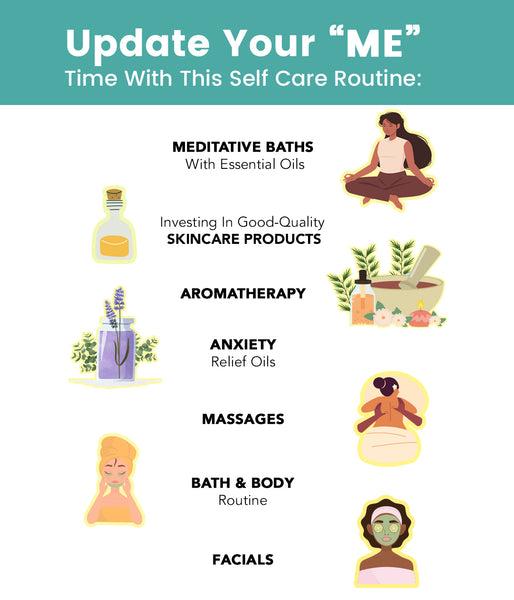
Mental wellness doesn’t require therapy (though that’s valuable and worth trying if you haven’t). Several evidence-based practices can shift your baseline significantly.
Practices That Moved the Needle
📓 Three-line journaling
Full journaling felt like homework. Instead, I started writing three things every morning: what I was worried about, what I was looking forward to, and one thing I was grateful for. Takes four minutes. Gets thoughts out of your head and onto paper, which genuinely reduces their emotional weight.
🌿 Time in nature — even briefly
A 20-minute walk in a green space (a park, a garden, anywhere with trees) measurably reduces cortisol levels. You don’t need a forest or a mountain — city parks work. “Green time” is a legitimate mood intervention, not a woo wellness concept. Research from places like Stanford and the University of Michigan backs this solidly.
📵 Intentional device-free time
Not a full digital detox — just 30–60 minutes a day where your phone stays in another room. During meals, during the first hour of morning, during the last 45 minutes before sleep. The constant micro-stimulation of notifications keeps your nervous system in a low-grade alert state. Space from it allows that system to reset.
Apps worth trying: Headspace and Calm both offer solid guided meditation for beginners. Waking Up (by Sam Harris) is better for those who want the science and philosophy alongside the practice. Even five minutes of guided breathing daily shows measurable anxiety reduction in studies.
Social Wellness — The Forgotten Pillar
Loneliness has a bigger impact on mortality than smoking 15 cigarettes a day, according to research from Brigham Young University. That statistic sounds dramatic, but it makes sense when you consider how deeply social connection is woven into human health — immune function, hormonal balance, even physical pain tolerance all shift with the quality of our relationships.
Modern life makes isolation easy. Remote work, social media as a substitute for in-person connection, and busy schedules all chip away at genuine relationship time without us even noticing.
Small Moves That Helped
📞 Scheduled calls over sporadic ones
Putting a weekly or biweekly call with a close friend or family member in your calendar sounds overly formal, but it transforms “we should catch up sometime” into an actual relationship. Spontaneous connection rarely happens as much as we intend.
🧑🤝🧑 Activity-based socializing
Sitting across a table and making conversation can feel draining for some people. Side-by-side activities — walking, cooking together, playing a game, doing a class — remove the pressure of constant eye contact and create natural shared experience. These often build deeper connection than formal social events.
Common Wellness Mistakes Worth Avoiding
Most of these I made personally, which is exactly why they’re worth flagging.
Starting too many things at once: Overhauling sleep, diet, exercise, hydration, and meditation simultaneously sounds efficient. It collapses within two weeks. Pick one thing, make it automatic, then add the next. Behavior change research is clear on this — sequential habit adoption is dramatically more successful than parallel.
Measuring the wrong things: The scale is a terrible daily metric for health. It fluctuates by 2–3 pounds based on water, sodium, and digestion — none of which reflect actual fat change. Energy levels, sleep quality, mood stability, and workout performance are far more accurate signals of progress.
Confusing productivity with wellness: Taking rest seriously, saying no to things, spending time doing nothing in particular — these are not laziness. Recovery is part of health. Treating every hour as an opportunity to optimize something is a fast path to burnout.
Relying only on motivation: Motivation is a feeling. Feelings are unreliable. Systems, environment design, and social accountability are more durable. Putting your running shoes next to your bed does more for your morning walk than any inspirational quote.
Building a Routine That Doesn’t Feel Like a Cage
Routines get a bad reputation because they’re often presented as rigid schedules. But a routine is really just a set of defaults — what you do when you’re not thinking about it. Defaults can be flexible and still be powerful.
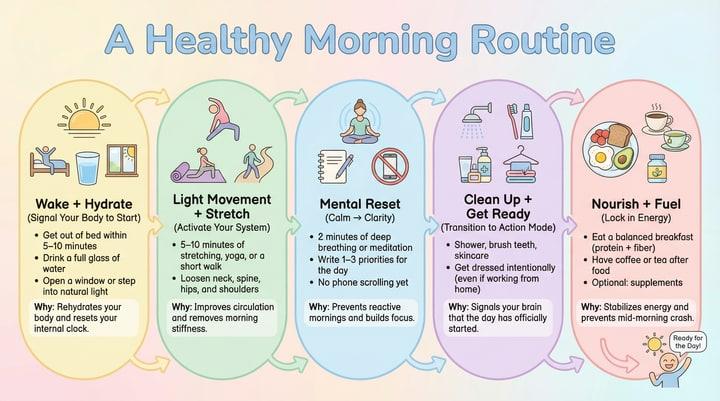
A Simple Morning Stack (Adaptable)
- Wake same time — no snooze, same time regardless of day.
- Water immediately — before anything else, drink 500ml.
- Three-line journal — four minutes, pen on paper.
- Movement — even a 15-minute walk counts. This is non-negotiable but flexible in form.
- Protein-forward breakfast — eggs, Greek yogurt, cottage cheese, protein smoothie. Anything that prioritizes protein over carbs sets blood sugar up for a more stable morning.
That whole sequence takes about 45 minutes. None of it is dramatic. All of it compounds over weeks into something that actually changes how you feel.
An Evening Wind-Down (Simple Version)
- Stop eating 2–3 hours before sleep — digestion disrupts sleep quality.
- Phone in another room or face-down — 60 minutes before bed.
- Low light, cooler temperature — signal to your body that it’s time to wind down.
- Something calming — reading, light stretching, quiet music, or just lying down with no agenda.
Real Results Take Longer Than You Think (And That’s Fine)
Wellness content tends to promise fast results because fast results sell. “Transform in 30 days” is more clickable than “feel meaningfully better over six months.” But the honest timeline is closer to the latter.
Sleep quality improvements start showing up within one to two weeks of consistent changes. Fitness benefits — even from walking — become noticeable around six to eight weeks. Dietary changes affect energy and digestion within a few weeks but take two to three months to shift body composition meaningfully. Mental health habits like journaling and meditation tend to show real effects around four to six weeks of consistent practice.
None of these timelines are catastrophically long. But they’re long enough that impatience kills most wellness attempts before they have a chance to work. The people who maintain good health habits long-term aren’t more disciplined — they’ve just been doing it long enough that it stopped feeling like effort.
Where to Start Today
If you take nothing else from this, take this: pick the one area where you feel the most friction in your daily life right now. Sleep, energy, mood, movement, eating — whatever comes to mind first. Start there. Not everywhere at once. Just there.
Make one small change that lowers the threshold for that habit. Set your water bottle on your desk tonight. Put your walking shoes by the door. Set a consistent alarm. Something that asks almost nothing of you right now but points in a better direction.
Wellness isn’t a destination you reach and then maintain. It’s a practice you return to, repeatedly, in slightly different forms across different seasons of life. The goal isn’t perfection — it’s trajectory. Keep pointing in the right direction and you’ll be surprised how far you travel.